How to Scrape Etsy: The Ultimate Guide No-Code solution with apify
Imagine having a direct window into a $30 billion marketplace teeming with millions of active shops and buyers. Etsy’s massive digital footprint makes it an absolute goldmine for e-commerce intelligence, yet most sellers and researchers navigate it completely in the dark. Whether you are trying to uncover highly profitable product niches, conduct real-time competitor pricing strategy analysis, or decode customer sentiment through review analysis, web scraping is your ultimate competitive advantage. However, extracting this data isn’t as simple as clicking a button; Etsy employs strict anti-scraping frameworks, including rapid IP bans and aggressive CAPTCHAs, to keep data locked down.
In this comprehensive guide, we will break down exactly how to bypass these roadblocks. By the end of this post, you will walk away with actionable Python strategies and seamless no-code methods to extract the Etsy data you need safely and efficiently.
What is Etsy Web Scraping?
Etsy web scraping is the automated process of extracting public data such as product titles, prices, star ratings, and review text from the Etsy marketplace. It works by sending programmatic requests to the website and parsing the HTML architecture to structure disorganized web pages into clean, usable data formats like CSV or JSON. For e-commerce businesses, it provides a reliable method to monitor market trends and optimize pricing strategies in real time.
Why Scrape Etsy Data?
You should scrape Etsy data to automate your market research and back your e-commerce decisions with concrete numbers instead of guesswork. Gathering this information manually by clicking through thousands of pages is simply impossible at scale. By using scrapers, you can harvest clean data around the clock to fuel three critical business strategies:
- Uncovering Profitable Product Niches: By extracting sales volumes, listing ages, and tags from top shops, you can easily identify exploding product trends and find underserved categories before they become oversaturated.
- Real-Time Competitor Pricing Strategy Analysis: Tracking how top competitors adjust their retail prices, shipping costs, and seasonal discounts allows you to keep your own margins highly competitive without losing your profit.
- Sentiment Analysis via Customer Reviews: Scraping thousands of buyer reviews lets you run text analysis to understand exactly what customers love and what they complain aboutgiving you the blueprint to build a better version of that product.
How Does Etsy Defend Against Scraping?
Etsy defends against scraping by using advanced bot-detection systems and web application firewalls that actively monitor incoming traffic for non-human behavior. If you run a basic script that shoots hundreds of requests to their server in a few seconds, their system flags your activity almost instantly. To keep their platform stable and protect their data, they deploy two main defensive barriers:
- IP Bans and Rate Limiting: Etsy sets strict limits on how many pages a single IP address can visit per minute. If your script crosses that threshold, your IP address will be temporarily blocked or permanently blacklisted, cutting off your access to the site.
- Aggressive CAPTCHAs: The platform uses smart security challenges (like Cloudflare gates) that trigger automatically when traffic patterns look automated. Once a CAPTCHA is thrown, a standard scraping script gets stuck because it cannot click the boxes or solve the puzzles like a human can.
To successfully extract data, your tools must be smart enough to mimic real human browsers, scatter request timings, and route traffic through rotating proxies.
Quick Comparison: Which Etsy Scraping Method is Best for You?
To choose the best Etsy scraping method for your specific project, you need to weigh your technical comfort level against the volume of data you plan to extract. There is no single best approach; the right choice depends entirely on whether you want a quick data pull without writing code or a highly customized, automated data pipeline.
The structured comparison table below breaks down the four primary ways to scrape Etsy so you can choose the path that fits your budget, skills, and data goals.
| Scraping Method | Technical Skill Required | Best For… | Key Tools |
|---|---|---|---|
| No-Code Cloud Scraping | None (Visual click-and-point / Online forms) | Fast, highly scalable extraction of specific shop or product search data without managing infrastructure. | Apify, Browse AI, Octoparse |
| Browser Extensions | None (Simple click-to-extract interface) | Small-scale data capture right from your live browser window for quick, ad-hoc research. | Etsy Scraper Suite, Web Scraper (Free) |
| Custom Python Script | Intermediate (Python coding and HTML parsing knowledge) | Total control over custom data pipelines, unique filtering, and heavy automation. | Requests, BeautifulSoup, Pandas, Selenium |
| Direct Scraping APIs | Low to Mid (Basic API integration knowledge) | Large-scale operations needing managed proxy rotation and automated CAPTCHA solving out of the box. | ScraperAPI, Bright Data, ZenRows |
How Do You Choose the Right Tool?
You can narrow down your choice by asking yourself two quick questions: how much data do you need, and how often do you need it?
If you are a non-technical e-commerce seller looking to analyze a competitor’s shop once a month, a No-Code Cloud Scraper or a simple Browser Extension will give you a clean CSV file in minutes without any setup headaches.
On the other hand, if you are building an enterprise-grade market intelligence tool that tracks thousands of Etsy listings daily, building a Custom Python Script backed by a Direct Scraping API is the only way to scale your operations while successfully flying under Etsy’s anti-bot radar.
The No-Coder’s Guide: How to Scrape Etsy in Minutes Using Apify
You do not need to know a single line of Python code to extract valuable marketplace intelligence from Etsy. While writing custom scripts is a fantastic approach for developers, e-commerce sellers and store managers often need clean data immediately to make fast business decisions.
By using Apifya cloud-based web scraping and data extraction platform you can completely bypass Etsy’s strict anti-bot firewalls, IP blocks, and CAPTCHAs. Apify utilizes “Actors,” which are pre-built, ready-to-use cloud scrapers that handle all the complex data-gathering background tasks for you. This guide will show you how to pull thousands of data points directly into an Excel spreadsheet or Google Sheet using simple online forms.
The 3 Essential Etsy Scrapers to Use
To scrape Etsy efficiently without code, you should use specialized tools designed for specific types of pages rather than trying a one-size-fits-all approach. The getdataforme suite on the Apify Store offers three distinct ready-made scrapers tailored to your specific research goals:
- Etsy Product Search Scraper: You feed this tool a standard search result URL or search keyword, and it automatically extracts product titles, current prices, listing IDs, tags, shipping details, and primary image links.
- Etsy Seller Info Scraper: You use this scraper to spy on competitor storefronts. It uncovers deep store-level data including total sales volumes, exact shop locations, seller bios, active listing counts, and connected social media profiles.
- Etsy Review Scraper: You deploy this tool to download complete historical buyer reviews, star ratings, review dates, and purchase verifications from any specific shop, giving you a massive text file perfect for sentiment analysis.
Step-by-Step Execution Blueprint
To extract data using Apify, you just need a web browser and the specific Etsy links you want to target. Follow this four-step blueprint to run your first cloud scraper in under five minutes:
-
Create an Account: Go to Apify’s website and sign up for a free account. The platform gives you free monthly platform usage credits, which are more than enough to scrape thousands of Etsy listings without entering a credit card.
-
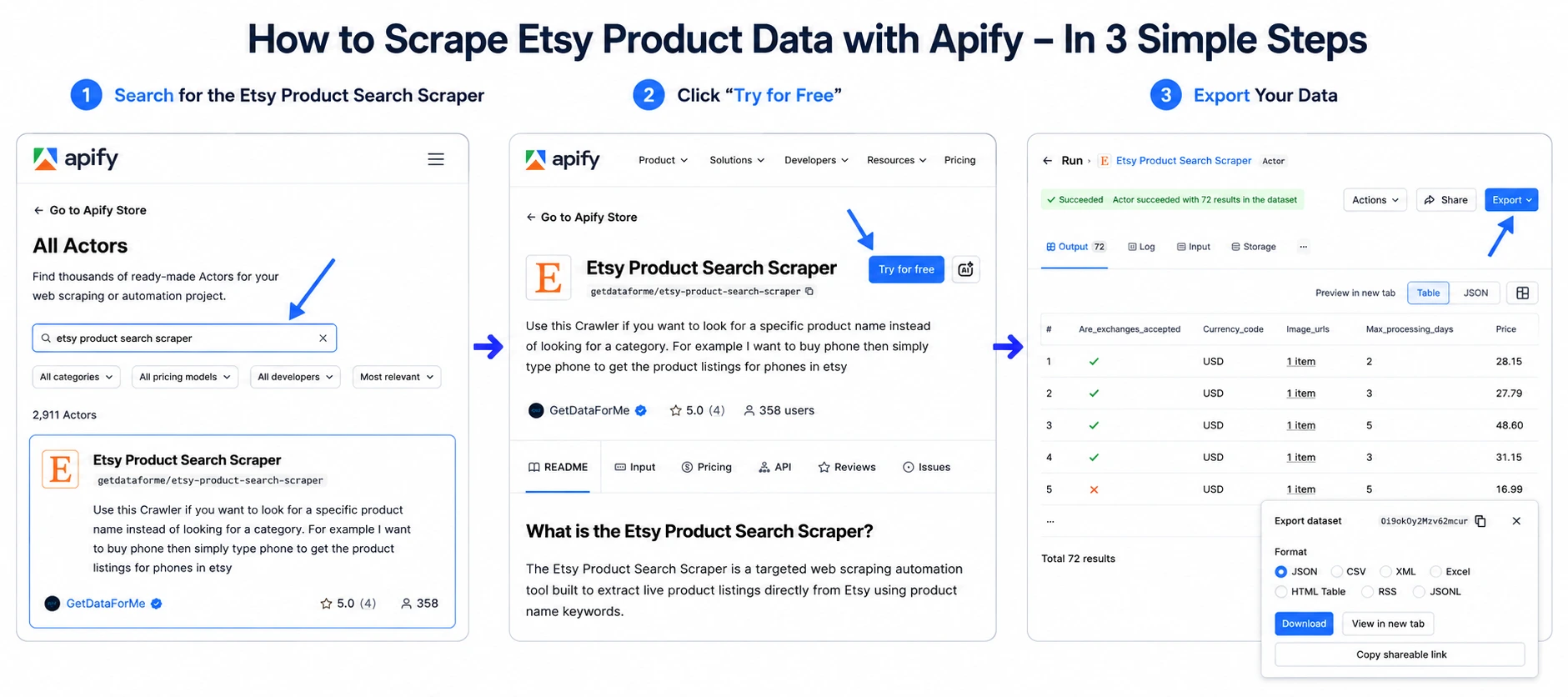
Select Your Actor: Navigate to the Apify Store tab on your dashboard and search for the pre-made getdataforme scrapers (such as Etsy Product Search Scraper or Etsy Review Scraper). Click Try for free to load the scraper interface into your console.
-
Configure the Input Form: Open a new browser tab, go to Etsy, and perform your target search or find the competitor shop you want to research. Copy the URL from your browser address bar, paste it into the Start URLs or Shop Names field in Apify, and set your data limits (for example, setting the maximum items to 500 products to keep your run short).
-
Run & Export: Click the green Start button at the bottom of the page. Apify’s cloud browsers will instantly spinning up, automatically route your requests through rotating residential proxies to bypass Etsy’s anti-scraping defenses, and gather the data. Once the status changes to “Succeeded”, head over to the Export tab to download your fresh dataset directly as a CSV or Excel file.
Bonus Automation: Syncing Your Data to Google Sheets
You can completely automate your market research workflows by connecting your Apify dashboard to your favorite daily productivity apps. Instead of manually downloading CSV files every time a cloud run finishes, you can use a no-code automation platform like Zapier or Make.
By creating a simple workflow trigger (“When a new dataset item is added in Apify, create a new spreadsheet row in Google Sheets”), you can build a live, self-updating dashboard. This lets you track competitor price changes or fresh customer reviews completely on autopilot while you focus on scaling your store.
Overcoming the Hurdles: How No-Code Tools Bypass Etsy’s Anti-Bot Systems
When you transition from browsing Etsy as a consumer to extracting its data as a business analyst, you quickly discover that you cannot simply copy and paste your way to a comprehensive spreadsheet. Etsy protects its platform with highly sophisticated anti-scraping frameworks designed to keep automated scripts out. If you try to manually pull data too quickly or run a basic browser script, the platform will immediately flag your activity, triggering aggressive CAPTCHAs, rate limits, or temporary IP bans that lock you out completely.
For non-technical users, this is where pre-built cloud platforms like Apify step in to save the day. The reason these tools work so seamlessly is because they deploy an invisible layer of enterprise-grade technology behind a simple click-and-point interface.
The Hidden Tech: How No-Code Platforms Emulate Humans
To understand why no-code cloud tools can gather thousands of data points without hitting a wall, we have to look at the advanced infrastructure they run in the background. They bypass Etsy’s anti-bot defenses by mimicking real human behavior across three distinct technical layers:
- Automated Residential Proxy Routing: Instead of sending data requests from a centralized data center server, which security firewalls block instantly, no-code tools automatically route their traffic through a vast pool of residential proxies. These are legitimate IP addresses assigned by internet service providers to real households. To Etsy’s security perimeter, the scraping requests look exactly like hundreds of individual shoppers browsing from their home computers scattered across the globe.
- Browser Fingerprint Randomization: Every time a browser connects to a website, it broadcasts a unique fingerprint containing information about its operating system, screen resolution, available fonts, and hardware. Security tools look for uniform or incomplete fingerprints to catch basic bots. Cloud scrapers use statistical machine learning algorithms to generate completely randomized, highly realistic browser fingerprints for every request, perfectly blending in with organic human traffic.
- Smart Behavioral Mimicry: Pre-built tools do not just request data in rigid, mechanical patterns. They are coded to introduce randomized delays, simulate natural mouse movements, and handle hidden background JavaScript challenges automatically.
By handling these complex engineering hurdles out of the box, no-code platforms allow you to focus entirely on analyzing your data rather than fighting server blocks.
Business Value: How Scraped Data Boosts an Etsy Seller’s Sales
Extracting marketplace data is only half the battle. The true power of web scraping lies in how you apply that information to grow your storefront, increase your conversion rates, and outmaneuver rival shops. For an Etsy seller, data is the ultimate equalizer that allows a small handmade business to compete directly with massive, established storefronts.
By turning raw web pages into structured spreadsheets, you can move away from guesswork and build a highly profitable shop. Here are four actionable business strategies you can implement immediately to boost your sales using scraped data.
Implement Dynamic, Profit-Optimized Pricing Strategies
Blind pricing kills your profit margins and stunts your growth. When you guess your retail prices or base them solely on your material costs, you risk hurting your brand. Scraping allows you to continuously extract competitor pricing models for identical or similar items across your entire niche.
By tracking these numbers over time, you can easily identify the market sweet spot. You will discover if you are underpricing your handcrafts and leaving money on the table, or if you are accidentally pricing yourself out of a coveted Bestseller badge. With this data in hand, you can confidently set prices that protect your profit margins while remaining highly attractive to shoppers.
Reverse-Engineer Competitor SEO & Keyword Strategies
You can crack Etsy’s search algorithm by analyzing the backend data of the shops that currently dominate the first page. When you extract product listings using an Etsy search scraper, you do not just get visible titles; you also pull hidden metadata, including product tags, optimized listing structures, and specific category paths.
This data allows you to see exactly what keywords your top-ranking competitors use to attract buyers. Instead of brainstorming tags in the dark, you can build a database of proven, high-converting search phrases. Tweaking your own listing titles and tags with these discovered terms will instantly lift your organic impressions and bring more buyers to your store.
Capitalize on Competitor Stockouts
Monitoring your rivals’ supply chains gives you a massive tactical advantage during peak shopping seasons. You can track your direct competitors’ listing details over days or weeks to watch their inventory counts fall and see exactly when warning badges like “Only 3 left” show up on their pages.
When a major competitor completely runs out of stock on a trending product, you can move quickly to capture their stranded audience. By scaling up your Etsy Ads spend and increasing your own production lines the moment they stock out, you can sweep up the organic overflow of customers who are looking for an immediate purchase.
Turn Customer Reviews Into Your Product Roadmap
You can design better products by letting your competitors’ unhappy customers tell you exactly what to build. Using an Etsy review scraper, you can bulk-extract thousands of feedback rows from rival storefronts and filter the dataset down to show only 1-star and 2-star reviews in your spreadsheet.
Reading these customer pain points at scale gives you a flawless blueprint for product development. If buyers consistently complain that a competitor’s handmade jewelry breaks easily, their candles tunnels, or their clothing sizes run too small, you can fix those specific engineering flaws in your own designs. You can then explicitly highlight your superior quality in your listing images and descriptions to win over hesitant buyers.
Summary Checklist & Next Steps
To turn these insights into actual business growth, you need to map out your technical execution pipeline. Web scraping works best when it follows a repeatable framework. By tracking your progress against a clear workflow, you can smoothly move from identifying opportunities to collecting clean datasets without getting stuck.
Follow this five-step action plan to launch your first successful data extraction campaign today:
- Define Your Target Data: Isolate the exact market indicators you need to track, such as competitor price points, high-performing search keywords, or low-rating customer complaints.
- Select Your Tool Scale: Choose the right extraction platform for your specific goals, using a simple browser extension for quick pulls under 50 items, or a robust cloud scraper like Apify for tracking massive batches of over 5,000 items.
- Run Extraction safely: Execute your scraping tool while routing your traffic through premium residential proxies or managed scraping APIs to protect your connection from sudden IP blocks.
- Export directly to Excel: Compile your raw data pools and download them as a structured CSV or Excel spreadsheet to build a clean baseline database.
- Filter and Analyze: Strip away the whitespace noise, sort your listings by sales volume or keyword frequency, and apply your findings directly to your storefront pricing and SEO strategies.
Frequently Asked Questions
What is the best way to scrape Etsy without coding?
The easiest way to scrape Etsy without coding is by using a cloud-based scraper like Apify. These tools handle proxy rotation, CAPTCHA challenges, and data extraction automatically, allowing users to collect Etsy product, shop, and review data through a simple interface.
Can I scrape Etsy product data?
Yes, you can scrape publicly available Etsy product data such as titles, prices, ratings, reviews, images, tags, and shipping information. This data can be used for market research, competitor monitoring, and pricing analysis.
Is Etsy scraping legal?
Scraping publicly available Etsy data is generally permitted for research and analytics purposes, but users should review Etsy’s Terms of Service and comply with applicable laws and regulations in their region before collecting data.
What data can I extract from Etsy?
You can extract product listings, shop information, seller profiles, customer reviews, ratings, product images, pricing details, shipping information, tags, and marketplace trends.
Why do Etsy sellers scrape competitor data?
Etsy sellers use scraped data to monitor competitor pricing, discover trending products, identify high-performing keywords, analyze customer feedback, and make more informed business decisions.
How can Etsy review data improve product development?
Analyzing Etsy reviews helps sellers understand customer preferences, identify recurring complaints, and discover opportunities to improve product quality, descriptions, packaging, and customer experience.
What are the challenges of scraping Etsy?
The main challenges include rate limits, IP bans, CAPTCHAs, browser fingerprint detection, and other anti-bot mechanisms designed to prevent automated access to the platform.
How do no-code Etsy scrapers bypass anti-bot systems?
Modern no-code scraping platforms use rotating residential proxies, browser fingerprint management, automated CAPTCHA handling, and human-like browsing behavior to reduce the likelihood of being blocked.
Can I export Etsy data to Excel or Google Sheets?
Yes. Most Etsy scraping tools allow you to export data as CSV, Excel, JSON, or directly sync datasets to Google Sheets using automation tools like Zapier or Make.
What is the best Etsy scraper for large-scale data collection?
For large-scale Etsy data extraction, cloud-based solutions such as Apify combined with specialized Etsy scraping actors provide scalable data collection, automatic proxy management, and reliable export options.
Can Etsy data help with keyword research?
Yes. Scraping Etsy listings can reveal popular keywords, product tags, category structures, and search trends that help sellers optimize their listings for Etsy SEO and increase visibility.
How often should I scrape Etsy data?
The ideal frequency depends on your goals. Daily scraping works well for price monitoring and competitor tracking, while weekly or monthly data collection may be sufficient for market research and trend analysis.